Relational coordination (RC) focus on how effective work is driven by strong relation and quality communications. It is generally about collaboration and communication between people within an organization, especially in interprofessional work, where different teams and different professions work together to solve shared goals. RC has two main focuses for good corporations between the different professions. First strong relations through shared goals, shared knowledge, and mutual respect. And secondly quality communication that should ideally be frequent, accurate, timely, and problem-solving.
RC can therefore be described as a circular interplay between those two factors: Relationships and communication.
If this interplay is well implemented, it will lead to a more efficient work (fewer errors and less wasted time) and healthier work environment (happier employees). This interplay will lead to a higher quality of the product and overall higher job satisfaction among employees.
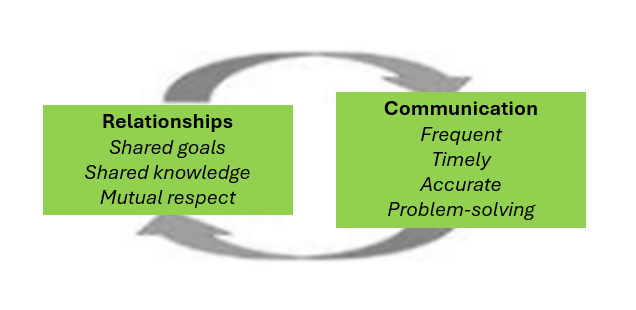
Inspired by model from the source
When effectively implemented, RC helps break down silo thinking by fostering stronger collaboration across teams and areas of responsibility. In doing so, it counters the effects of bureaucratic structures, where work tends to be divided into separate departments, increasing the risk of isolated thinking.
Interprofessional collaboration is a key component for any organization aiming to implement, sustain, and support relational coordination. To achieve this, elements such as cross-functional teamwork, conflict management, incentive structures, effective communication, and quality measurement are essential. These factors help foster a unified perspective - encouraging employees to see themselves as part of a single team working toward shared goals.
Focusing on RC is especially valuable in complex operations, where multiple teams from different organizations work across varied scopes. In such settings, RC supports more effective communication, stronger collaboration, and helps break down siloed thinking, ultimately contributing to the success of the project.
Source:
Gittel, J. H. Godfrey, M. Thistlethwaite, J. (2013). Interprofessional collaborative practice and relational coordination: Improving healthcare through relationships. Journal of care 2013 (27), 210-213. 10.3109/13561820.2012.730564