SWOT stands for Strengths, Weaknesses, Opportunities, and Threats. It is a widely used project management tool designed to help identify both potential opportunities and risks by examining internal and external factors affecting a business or project. The SWOT analysis was originally developed by Albert Humphrey, who led a major research project at Stanford University during the 1960s and 1970s. This tool can be particularly useful during the planning phase of a project, as well as for brainstorming before conducting a risk assessment. A SWOT analysis encourages you to clearly visualize what you or your organization does well, and where challenges or vulnerabilities may exist.
How to use a SWOT analysis?
The tool consists of four key factors: two internal and two external, with one positive and one negative in each category. Strengths and weaknesses are internal factors, while opportunities and threats are external. SWOT analysis is useful as a preparatory step for a larger, more detailed analysis. While it is rarely sufficient on its own, when combined with other tools, it can contribute to a more comprehensive understanding of a situation. The process involves going through each of the four factors and listing the most important insights related to strengths, weaknesses, opportunities, and threats. For better results, it’s a good idea to involve people with different perspectives and areas of expertise.
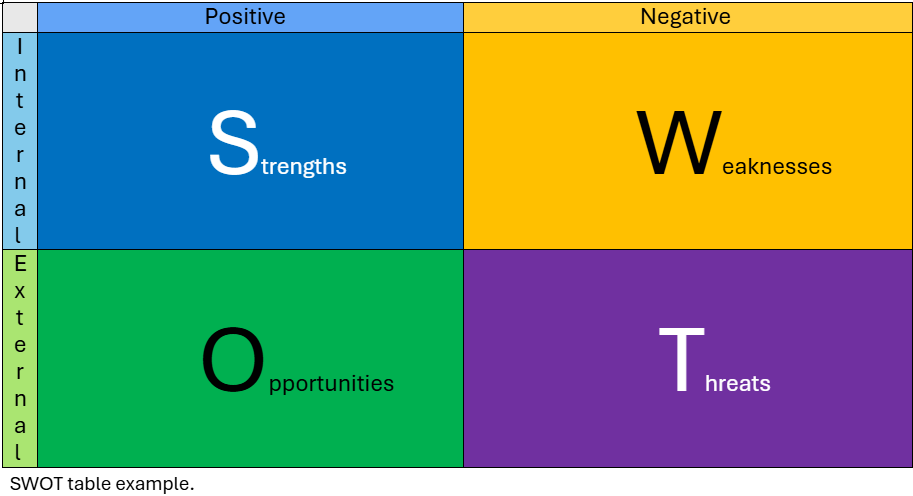
SWOT table example.
Strengths
Strengths refer to internal factors that can positively impact your project. These might include: A strong financial position, a high-quality product or service, loyal customers, skilled and effective employees, competitive advantages, or a solid and well-defined strategy.
Weaknesses
Weaknesses are internal factors that can negatively affect your project. Examples include: Financial instability, poor timing or planning, limited resources, unclear or unrealistic goals, competitive disadvantages, or an undefined or vague project scope.
Opportunities
Opportunities are external factors that can positively influence your project. These may involve: New investors or funding sources, economic growth, increasing consumer demand, or weak or unprepared competitors.
Threats
Threats are external factors that could harm your project. Examples include: Economic downturns or crises, disruptive new technologies, changes in laws or regulations, or unreliable or underperforming suppliers.
Benefit of using a SWOT analysis:
- Visualized where to have focus
- Structured thinking
- Alignment in a team
- Where is action needed
- What is the potential
- What is the biggest threat
- Smart for initial research
Sources:
Peterdy, K. (n.d.). SWOT analysis. Corporate Finance Institute. https://corporatefinanceinstitute.com/resources/management/swot-analysis/
SWOT-analyse. Få guides og skabeloner til dit arbejde med SWOT. (2014, June 4). Alt Om Ledelse. https://altomledelse.dk/swot-analyse/