Introduction:
Every day, whether as an individual or a large organization, people are forced to deal with risks. Risks come in many different forms, but the solution to managing those risks may vary depending on the situation. Fortunately, there are tools that risk managers at all levels can use to help them simplify their processes, convey their goals to others, and create an environment that contributes to a safer project or organization. One of these tools is the risk management checklist.
Purpose & Example:
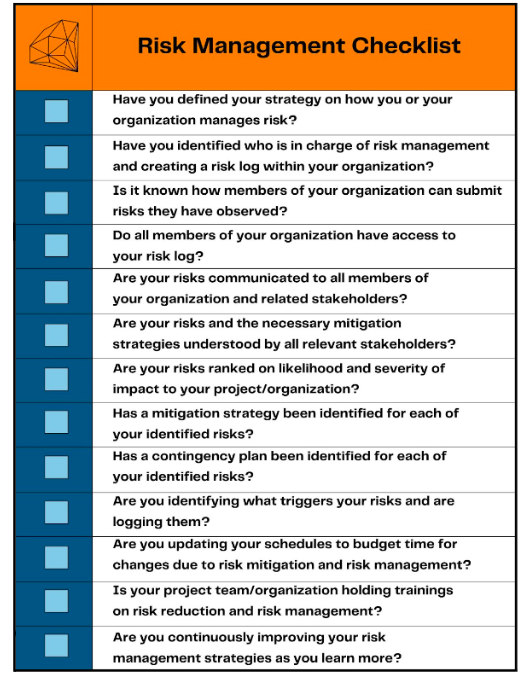
The purpose of a risk management checklist is to ensure that activities in your project are being accomplished and that risks are being reduced while doing so. Additionally, it allows for tracking risks across an organization and enables non-risk managers to easily evaluate what risks may exist in their organization or project. Below is a risk management checklist provided by the United States Center for Disease Control and Prevention (CDC) and modified by RoC Consult ApS. This checklist can be used for a variety of applications, including large projects and reducing risk within your organization:
Best Practices to Continuously Improve:
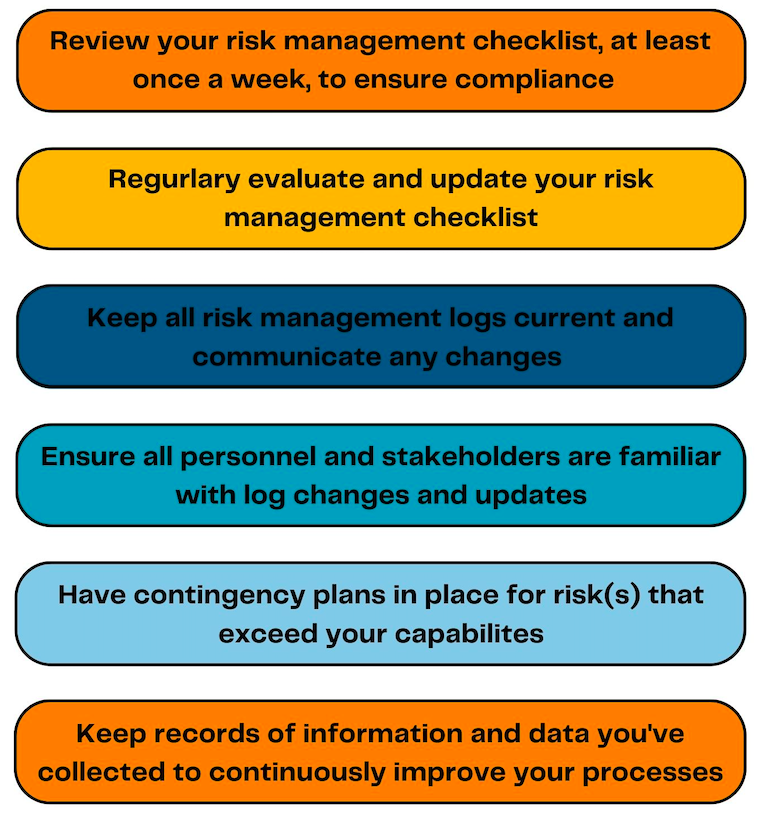
A risk management checklist, like the one shown above, can be beneficial for any large project or organization. However, these checklists must be continuously updated and improved. Checklists like these are of no help if they’re discarded in a desk drawer or buried among hundreds of files on someone's computer. To help you or your organization best use these checklists, some of the CDC’s best practices are provided below:
Conclusion:
The risk management checklist is only one of many tools used to manage risk within your organization or on a large project. We encourage you to use the provided checklist or create your own to best suit your risk management objectives. We also stress the importance of keeping your checklist up-to-date and improving it as you learn more about your risks. There is no simple “one-size-fits-all” approach to risk management. However, we hope this tool can be a resource for you or your organization.
Source Used:
“CDC Unified Process Checklist.” Center for Disease Control and Prevention, 11 November 2006, https://www2a.cdc.gov/cdcup/library/checklists/CDC_UP_Risk_Management _checklist.pdf