When working with any type of hazard, it is important to know, how effective your preventive and mitigative measures are. This can be done in a lot of ways – one of those being a ranking based on a classification of those barriers. This article will explain the Hierarchy of Controls, and how to use it in Risk Management.
Understanding the Hierarchy of Controls:
The Hierarchy of Controls is a principle created by the National Institute for Occupational Safety and Health (NIOSH). It provides 5 “boxes” in which you can classify your measures/actions (or barriers, if you combine it with a Bow-Tie Diagram).
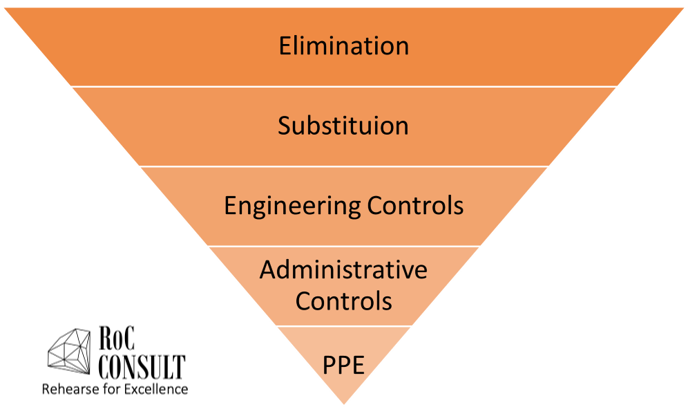
As illustrated above, this principle is usually depicted as an inverted triangle split into 5 categories. Those being: Elimination, Substitution, Engineering Controls, Administrative Controls and PPE.
Elimination is a physical removal of the hazard. This means, that if you identify some sort of work-related hazard, and it is possible to remove it in some way, doing that will make the working process safer, as the risk of exposure is reduced.
Substitution is about finding alternative materials. This can for instance mean replacing some sort of chemical compound with a safer alternative. Beware though, substitution means bringing in new elements that can also pose a risk. Keep that in mind.
Engineering Controls is about creating a distance between the worker and the hazard using mechanical tools, electrical tools etc. These technical measures can create a safer work environment for the operator.
Administrative Controls deals with the organizational changes, that can create a safer work environment. If the Standard Operating Procedure (SOP) for example describes providing adequate and continuous training as part of the work routine, this would be an administrative control.
The last category is Personal Protective Equipment or PPE. Personal Protective Equipment is usually being used, if it’s impossible to reduce the risk in any other way – often due to the nature of the work performed.
Implementation of the Hierarchy of Controls:
The Hierarchy of Controls can help determine the robustness in a work environment. With knowledge of this principle, you are able to create an overview of your preventive or mitigating barriers.
The most effective actions, in terms of controlling a hazard, are the ones at the top end of the model. Moving towards the bottom, the actions become less and less effective but can be easier to implement.
It is important to note, that barrier-variety is seen as a positive thing – meaning that implementation of Engineering Controls shouldn’t negate the implementation of PPE. It’s also a good idea to have several barriers for specific hazards or threats.
Sources:
- Centers for Disease Control and Prevention (https://www.cdc.gov/niosh/topics/hierarchy/default.html)